Is real estate a good investment? This is one of the most common questions people ask when they start thinking about their financial future. The short answer is yes, but it depends on how you go about it. Real estate has helped many people build wealth over time. It can give you steady monthly income, tax benefits, and a property that grows in value. But it is not simple or easy. You need money to start. You need to understand the market. You need to be ready for the work that comes with being a landlord.
For beginners, the risks are real. You could lose money if you buy in the wrong place or at the wrong time. You could face costly repairs that eat up your profits. You could struggle to find good tenants. Yet, with the right plan and a clear understanding of what you are getting into, real estate can be a powerful tool for building long-term wealth. This guide will walk you through everything you need to know before you make that first move.
What Does "Good Investment" Mean for You?
Before you look at any property, you need to look at yourself. Why do you want to invest? This is the most important first step . Your goals will shape everything you do.
Are you trying to build long-term wealth? Do you want a monthly income to help pay bills? Or do you feel pressure to buy because prices are going up? These are not the same things. You need a clear reason for buying .
Some people want to get rich quick by flipping houses. Others want a slow and steady income from renters. Both are fine. But you need to pick one path. Your "why" will help you decide where to buy and what kind of property to get .
Think about how long you want to hold the property. Do you want to sell it in a few years? Or do you want to keep it for a decade or more? Your timeline affects your risk. Short-term goals are often riskier. Long-term goals give you time to ride out the market's ups and downs .
Also, think about your comfort with risk. Some people are okay with big swings. They can handle the stress of a flip. Others want something stable. They prefer a long-term rental that brings in steady cash . There is no wrong answer. But you must be honest with yourself.
Read More: How to Make Money in Real Estate for Beginners

The Good Side of Real Estate
There are many reasons people choose real estate over stocks. It offers some unique benefits. Here are the main ones.
Steady Income from Rent
If you buy a property and rent it out, you get monthly income. This is called cash flow. The money from rent can cover your mortgage. It can also pay for taxes and insurance. If you do it right, you will have money left over each month .
This is different from stocks. Stocks pay dividends, but they are not guaranteed. Rent is more predictable. You know what you will collect each month. This gives you financial stability .
Your Property Grows in Value
Over time, most properties go up in price. This is called appreciation. You buy a house for $200,000. Ten years later, it might be worth $300,000. That is a big profit when you sell .
Appreciation is not guaranteed. Markets can crash. But historically, real estate goes up over the long term. This is why patient investors do well. They hold onto properties for many years .
Tax Benefits You Cannot Get with Stocks
The government gives property owners some nice tax breaks. You can deduct the interest you pay on your mortgage. You can deduct property taxes. You can also deduct the cost of repairs and insurance .
There is also something called depreciation. This lets you deduct a portion of the building's cost each year. You do not get this with stocks. These tax breaks can save you thousands of dollars .
You can also use a 1031 exchange. This lets you sell a property and buy another one without paying taxes on your profit right away. It is a powerful tool for growing your wealth .
A Tangible Asset with Low Volatility
Real estate is a physical thing. You can touch it and see it. That gives people a sense of security. When you own a house, you own something real. This is different from a stock, which is just a piece of paper .
Property values do not go up and down as fast as stocks. Stocks can drop 20% in one day. Real estate is much more stable. It does not fluctuate as often or as dramatically . This makes it a good way to balance your portfolio.
You Can Use Leverage
Leverage is a fancy word for using a loan. You do not need to pay for the whole house in cash. You can put 20% down and borrow the rest. This lets you control a big asset with a small amount of money .
Let's say a house costs $200,000. You put down $40,000. The house goes up 10% to $220,000. You made $20,000 on your $40,000 investment. That is a 50% return. This is the power of leverage. It can boost your profits.
But leverage is a double-edged sword. If the house goes down 10%, you lose $20,000. That is half of your money. So leverage can also boost your losses. You need to be careful .
The Risks and Bad Parts
It is not all good. There are real risks to investing in real estate. You need to know them before you start.
High Upfront Costs
Buying a house is expensive. You need a down payment. For investment properties, this is often 20% to 25% . On a $300,000 house, that is $60,000 or more. You also have closing costs, which can be thousands more.
You cannot forget about repairs. Many investment properties need work. You might need to fix the roof or replace the HVAC. These costs can be a big surprise. Experts say you should have at least 1% to 2% of the property value saved for maintenance each year .
Management Is Hard Work
Being a landlord is not passive. It is a job. You have to find tenants. You have to collect rent. You have to fix things that break in the middle of the night. Some tenants are difficult. They might pay late or damage the property .
If you do not want to do this work, you can hire a property manager. But they cost money. Most charge around 10% of the monthly rent . This eats into your profits. But it can be worth it to save your time and sanity.
You Cannot Sell Fast
Real estate is not liquid. This means you cannot sell it quickly. It might take months to find a buyer and close the deal. If you need cash in a hurry, you are stuck .
This is a big difference from stocks. You can sell a stock in seconds. With real estate, you have to wait. This is why you should only invest money you can leave alone for a long time.
All or Nothing with Tenants
If you own a single-family rental, you have one tenant. If they move out, you lose all your rental income. This can be a big problem. You still have to pay the mortgage, even with no rent coming in .
This is called a vacancy. It is normal in real estate. Smart investors plan for it. They set aside money to cover the mortgage for several months with no rent. This gives them a safety net .
Not a Guaranteed Hedge
Some people say real estate is a hedge against inflation. This means it protects you when prices go up. In general, this is true. Rents and property values tend to rise with inflation.
But it is not guaranteed. In some markets, prices can fall even during high inflation. You can lose your entire investment if you buy at the wrong time or in the wrong place . You cannot assume your property will always go up.
You May Also Read: Best Property Investment Strategies for Beginners to Earn Passive Income
Different Ways to Start
There is more than one way to invest in real estate. Each path has its own pros and cons. The best one depends on your budget, your time, and your goals.
Real Estate Investment Trusts (REITs)
A REIT is a company that owns income-producing real estate. You can buy shares of a REIT on the stock market. It is the simplest and most passive way to invest .
How it works: You buy shares like a stock. The REIT uses your money to buy properties like malls, offices, or apartments. They rent out these properties. They pass most of the rental income to you as dividends .
The good: You can start with very little money. You just buy one share. You do not have to deal with tenants or toilets. It is very liquid. You can sell your shares anytime .
The bad: You have no control over the properties. Your investment is tied to the stock market. The value goes up and down every day. Dividends are taxed as ordinary income, not capital gains .
Who it is for: Investors with a low budget who want to be completely hands-off. It is a good starting point to learn about real estate.
Buying a Rental Property
This is the most direct way to invest. You buy a house, condo, or apartment. You rent it out to a tenant. You get the monthly income. You also benefit if the property goes up in value .
How it works: You find a property. You put down a deposit. You get a mortgage. You find a tenant and collect rent. You use the rent to pay the mortgage and other costs. You keep the leftover profit .
The good: You have full control. You choose the tenant and the rent. You can deduct many expenses from your taxes. You benefit from appreciation over time. You can also use leverage to boost your returns .
The bad: It requires a big down payment. You need to manage the property or pay a manager. It is not liquid. You cannot sell fast. You have to deal with maintenance and repairs .
Who it is for: People who have enough capital saved. They are willing to commit time and effort. They want maximum control over their investment.
House Hacking
House hacking is a smart way to start. You buy a multi-unit property, like a duplex or a fourplex. You live in one unit. You rent out the other units .
How it works: You buy a two-to-four-unit property. You live in one part. You rent out the other parts. The rent from your tenants pays your mortgage. You can live for free or very cheaply .
The good: The barrier to entry is low. You can use an FHA loan with a down payment as low as 3.5%. You get hands-on experience as a landlord. You reduce your biggest living expense. It is a low-risk way to get started .
The bad: You live very close to your tenants. This can be awkward. You are responsible for maintenance. It limits your property options. You need to find multi-unit buildings in your area .
Who it is for: People with a very low budget. They are willing to live next to their tenants. They want to reduce their housing costs while learning the business.
House Flipping
Flipping is buying a house that needs repairs, fixing it up, and selling it for a profit. It is the most exciting strategy. It is also the most risky .
How it works: You find a distressed property at a low price. You renovate it. You sell it quickly at a higher price. The profit is the difference between the sale price and all your costs .
The good: You can make a lot of money quickly. It is exciting. You get to be creative and improve properties. You learn a lot about construction and the market .
The bad: It is very risky. You can lose a lot of money if you make mistakes. It requires deep pockets. You need to pay for renovations and carrying costs like taxes and insurance. It is a lot of work and stress .
Who it is for: People with strong cash reserves. They are comfortable with high risk. They have good knowledge of construction and the market. They have an experienced partner to guide them.
Real Estate Crowdfunding
Crowdfunding lets you pool your money with other investors. You collectively fund a large project. This could be a commercial building or an apartment complex .
How it works: You invest through a crowdfunding platform. The platform finds the project and manages it. You become a part-owner. You get a share of the income and profits .
The good: Entry points are lower than buying a whole property. You are managed by professionals. You can diversify by investing in different projects across different locations. You avoid the stock market volatility of REITs .
The bad: Your money is locked up for years (often 3-7 years). It is not liquid. The success depends on the skill of the project sponsor. Some of the best deals are only open to wealthy individuals .
Who it is for: People with a moderate budget. They want a passive investment. They want to avoid the stock market. They are patient and can lock up their money for the long term.
A Simple Path for Beginners: The 4-3-2-1 Strategy
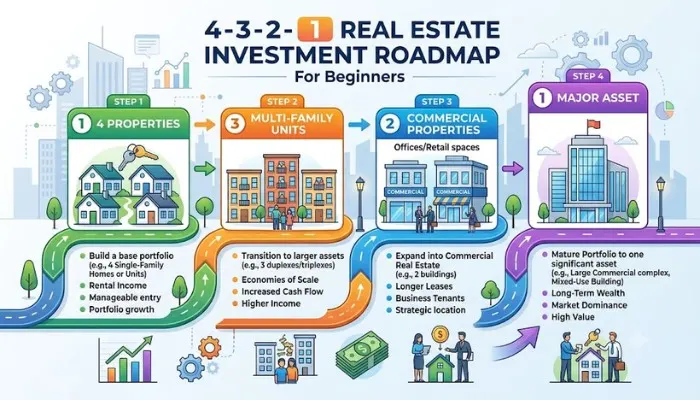
Starting can feel confusing. You might wonder which property to buy first. The 4-3-2-1 strategy gives you a clear roadmap .
Here is how it works:
-
Start with a fourplex: Buy a building with four units. Live in one. Rent out the other three. This gives you multiple streams of income from day one .
-
Move to a triplex: After you have experience, buy a three-unit property. This increases your cash flow. You apply what you learned from your first investment .
-
Get a duplex: With two units, you keep growing your income. You gain even more experience .
-
Finally, a single-family home: By now, you have cash flow and confidence. You can invest in a single-family rental for long-term wealth .
This strategy reduces your risk. You learn as you go. You start with big returns and move to smaller properties as your portfolio grows.
Financing Your First Property
Getting a loan is one of the biggest challenges. Here are some ways to fund your investment.
FHA Loans: If you live in the property, you can get an FHA loan. These loans have a down payment as low as 3.5%. They are great for house hacking .
Conventional Loans: These are standard mortgages. For investment properties, banks usually require 20% to 25% down .
Hard Money Loans: These are short-term loans from private lenders. They are based on the property value, not your credit. They have higher interest rates. They are often used for flipping .
Home Equity: If you already own a home, you can use its equity to buy an investment property. This can be a good source of funds .
What to Look For in a Property?
Location is the most important factor. A good location can make a bad property work. A bad location can ruin a good property .
- Look for areas with strong job growth: People move to where the jobs are. More people means more demand for housing .
- Look for a growing population: Areas with rising populations will have higher property values. Rents will also go up .
- Look at the local economy: Is the economy stable? Are there big employers in the area? This gives you a safety net .
Crime rates and community appeal: People want to live in safe, nice areas. Check the crime statistics. Look at the schools and amenities .
Building Your Team
You cannot do it alone. Successful investors build a team of experts around them .
- A Real Estate Agent: Find an agent who knows investment properties. They can help you find deals .
- A Mortgage Broker: They understand loans for investors. They can help you get the best financing .
- A Good Home Inspector: They will check the property for hidden problems. This saves you from expensive surprises .
- A Real Estate Attorney: They can help with contracts and legal issues .
- A Property Manager: If you do not want to manage the property, hire a manager. They handle the day-to-day work for a fee .
The Bottom Line
So, is real estate a good investment for beginners? The answer is still yes, but only if you are careful.
Real estate can build wealth over time. It offers steady income, tax benefits, and appreciation. But it is not a get-rich-quick scheme. It takes work, money, and patience.
The best strategy for a beginner is to start small. House hacking is a great option. It lets you live for cheap and learn the business. Or you can start with a REIT. This gives you exposure to real estate with no management headaches.
No matter what you choose, do your research. Build a good team. Have a clear plan. And be patient. Real estate is a long game. If you play it smart, it can change your life.
The key is to match the strategy to your life right now. Do not pick the one that makes the most money. Pick the one that lets you stay solvent, sane, and learning for the next five years . That is how you succeed in real estate.