
Keeping track of mortgage and interest rate news is essential for every homebuyer. Rates change almost daily. They directly affect your monthly EMI and the total interest you pay over the loan tenure. If you are planning to buy a home or refinance your existing loan, you cannot afford to ignore the latest updates.
This article brings you the most recent mortgage and interest rate news today, including data from trusted sources like CNBC mortgage rates today and national mortgage news. We explain what is driving these changes, how they impact your budget, and what you should do right now to get the best deal.
Current Home Loan Interest Rates in India (July 2026)
The latest mortgage and interest rate news shows that home loan rates remain stable. The Reserve Bank of India (RBI) kept the repo rate unchanged at 5.25% in its June 2026 monetary policy review . This was the fourth straight MPC meeting where the RBI held the rate steady .
Read More: AI Real Estate Investment: Easy Guide to Profitable Properties
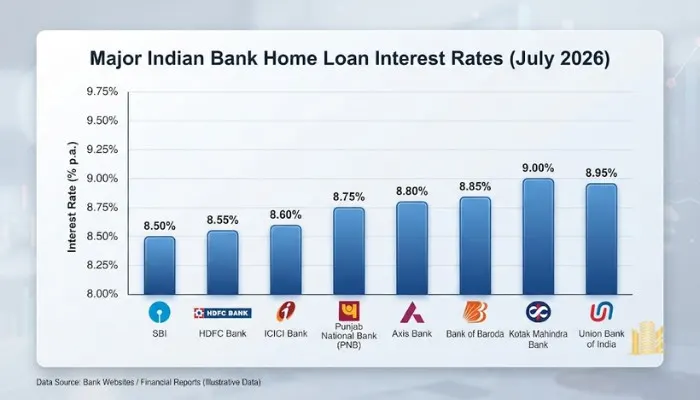
Here are the latest home loan interest rates from top banks and housing finance companies:
| Bank / HFC | Starting Interest Rate (p.a.) |
|---|---|
| Bank of India | 7.10% onwards |
| Bank of Maharashtra | 7.10% onwards |
| Central Bank of India | 7.10% onwards |
| Union Bank of India | 7.15% onwards |
| UCO Bank | 7.15% onwards |
| Indian Bank | 7.15% onwards |
| LIC Housing Finance | 7.15% onwards |
| Bank of Baroda | 7.20% onwards |
| Punjab National Bank | 7.20% onwards |
| State Bank of India | 7.25% onwards |
| Bajaj Housing Finance | 7.25% onwards |
| ICICI Bank | 7.50% onwards |
| HDFC Bank | 7.75% onwards |
| Axis Bank | 8.00% onwards |
These rates are for floating-rate home loans. The actual rate you get depends on your credit score, loan amount, and whether you are salaried or self-employed . Borrowers with a credit score of 800 or above are more likely to get the lowest rates.
How the Repo Rate Affects Your Home Loan?
The repo rate is the rate at which the RBI lends money to banks. It acts as the base for most home loan interest rates . When the RBI cuts the repo rate, banks can borrow money at a cheaper cost. They usually pass on this benefit to borrowers by reducing home loan rates. When the RBI hikes the repo rate, the opposite happens .
The Big News: Since early 2025, the RBI has cut the repo rate by a total of 125 basis points (from 6.50% to 5.25%) . This has been great news for home loan borrowers. Let us understand the impact with an example.
Savings on a Rs 50 Lakh Home Loan
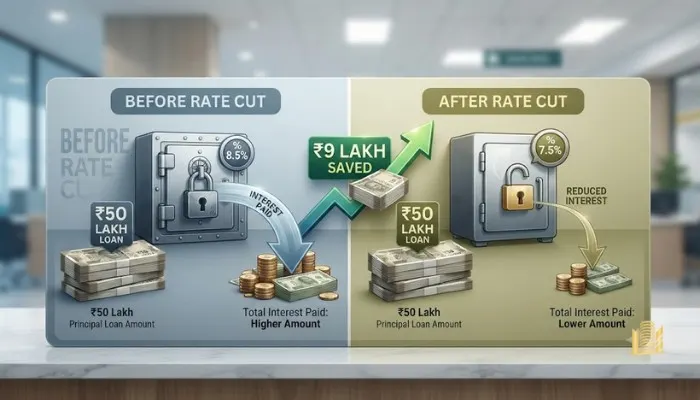
Imagine you took a home loan of Rs 50 lakh for 20 years. Here is how the 125 basis points rate cut has reduced your burden :
| Original Loan | After Rate Cut | |
|---|---|---|
| Interest Rate | 8.50% | 7.25% |
| Monthly EMI | Rs 43,391 | Rs 39,519 |
| Total Interest Paid | Rs 54.14 lakh | Rs 44.85 lakh |
| Interest Saved | - | Rs 9.29 lakh |
| EMI Saved Per Month | - | Rs 3,872 |
So, the cumulative 125 bps repo rate cut means you save nearly Rs 3,900 every month and over Rs 9 lakh in total interest over 20 years . This is a significant relief for middle-class families.
Good News: RBI Held Repo Rate in June 2026
The RBI kept the repo rate unchanged at 5.25% in its June 2026 meeting . What does this mean for you?
- Existing Borrowers: Your EMI will not change immediately. The benefits of the earlier rate cuts remain fully intact .
- New Borrowers: You can still avail of home loans at rates around 7% to 7.25% .
Experts believe this is a period of stability. Home loan interest rates are expected to remain broadly unchanged for now . For fintech lenders and banks, this stability helps maintain affordability for salaried professionals, self-employed individuals, and small businesses that are sensitive to monthly repayment obligations .
But There is a Catch: Inflation and Future Rate Hikes
While the current mortgage and interest rate news today is positive, there is a warning on the horizon. Inflation is rising. Fuel and energy prices have surged due to supply disruptions. The Rupee has fallen against the US Dollar, making imports costlier. India's inflation jumped from 2.74% in January to 3.48% in April 2026, with expectations of an even higher rate in May .
If inflation continues to rise, the RBI may have to hike the repo rate in future monetary policy meetings . A rate hike would mean banks will increase home loan rates. Your EMI could become costlier if you have a floating-rate loan .
Key Takeaway: The good times for home loan borrowers may not last forever. It is wise to use this low-rate period to reduce your debt.
MCLR: What It Means for Your Loan
Many older home loans are linked to MCLR (Marginal Cost of Funds-based Lending Rate). MCLR is the minimum interest rate below which a bank cannot lend . Unlike repo-linked loans, MCLR rates do not change immediately after a repo rate cut. The transmission is slower .
Recent MCLR Changes:
- HDFC Bank revised its MCLR rates effective July 7, 2026. The overnight MCLR was reduced by 5 basis points to 8.05%. But the one-year MCLR (which impacts home loans) was increased by 5 basis points to 8.45% .
- SBI's MCLR rates as of January 2026 are: Overnight 7.85%, One Month 7.85%, One Year 8.70% .
If your loan is linked to MCLR, you may not fully benefit from the RBI's rate cuts. Consider switching to a repo-linked loan if your lender allows it.
You May Also Read: Why Is the Stock Market Down Today? A Simple Guide for Everyone
How to Save Interest on Your Home Loan?
Even if rates stay stable, you can take steps to reduce your interest burden. Here are some practical strategies.
1. Home Loan Prepayment
Prepayment means paying a part of your loan before the scheduled time. This can save you a significant amount of interest. Banks allow prepayment without any charges on floating-rate loans.
Example: You have a Rs 50 lakh home loan at 8% interest with 20 years remaining. If you make a one-time prepayment of Rs 5 lakh (10% of the principal), you can save Rs 15.85 lakh in interest and reduce your loan tenure by 49 months (over 4 years) .
| Outstanding Principal | Tenure | Rate | Prepayment (10%) | Interest Saved | Tenure Saved |
|---|---|---|---|---|---|
| Rs 50 lakh | 20 years | 8% | Rs 5 lakh | Rs 15.85 lakh | 49 months |
| Rs 1 crore | 20 years | 8% | Rs 10 lakh | Rs 29.10 lakh | 49 months |
If you cannot make a one-time large payment, you can also pay one extra EMI every year. On a Rs 50 lakh loan at 8% for 20 years, paying one extra EMI each year can save you about Rs 10.17 lakh in interest .
2. Choose the Right Option After Prepayment
When you prepay, the bank gives you two options:
- Reduce EMI: Keep the tenure the same, but your monthly payment becomes smaller.
- Reduce Tenure: Keep the same EMI, but finish the loan much faster.
The second option saves you more interest . If you can afford the same EMI, choose tenure reduction to become debt-free sooner.
3. Compare Rates Across Banks
Do not settle for the first offer. Different banks offer different rates. As you can see from the table above, rates vary from 7.10% to 8.00%. Use this to negotiate with your current lender or consider a balance transfer to a bank offering a lower rate . Even a 0.25% difference can save you lakhs over 20 years.
4. Improve Your Credit Score
Banks offer the best rates to borrowers with high credit scores (800 and above) . Pay your credit card bills and existing EMIs on time. Keep your credit utilization low. Check your credit report regularly and correct any errors. A better score gets you a better rate.
CNBC Mortgage Rates Today vs Indian Market
CNBC mortgage rates today typically focus on the US market. In India, mortgage and interest rate news is driven by RBI policy, inflation, and bank-specific MCLR changes. While the global economy does impact India, the primary factor remains the RBI's repo rate.
For national mortgage news in India, keep an eye on RBI announcements, bank rate revisions, and economic data like inflation and GDP growth.
Future Outlook: What Experts Say
Experts are divided on the future. Some believe the current low rates will continue. The RBI may even consider a "jumbo rate cut" of 50 basis points if economic growth slows . Others warn that rising inflation could force the RBI to hike rates later this year .
For households, the immediate impact is stability. But borrowers should not be complacent. It is wise to use this period of stability to make prepayments and reduce your principal. Locking in at current rates makes sense before any potential hike .
FAQs
1. What is the current repo rate in India?
The current repo rate is 5.25%. The RBI held it unchanged in its June 2026 policy review.
2. Which bank has the lowest home loan rate in India?
Bank of India, Bank of Maharashtra, and Central Bank of India currently offer rates starting from 7.10% onwards. However, the actual rate depends on your credit profile .
3. What is MCLR and how does it affect my loan?
MCLR stands for Marginal Cost of Funds-based Lending Rate. It is the minimum rate a bank can lend. Home loans linked to MCLR see slower transmission of RBI rate changes compared to repo-linked loans .
4. Should I choose a fixed or floating rate home loan?
Floating rates are usually lower and adjust with market conditions. If you are comfortable with some risk, floating rates can save you money. Fixed rates offer stability but start higher. For most borrowers, floating rates are better in a declining rate environment.
5. Can I switch from MCLR to repo-linked loan?
Many banks allow you to switch from MCLR to repo-linked loans. There may be a small conversion fee. Compare the potential savings before making the switch.