
If you own investment property and want to sell it, you face a big problem. The government will take a large chunk of your profit. Capital gains tax and depreciation recapture can eat up 20% to 30% of your sale proceeds. This is where the 1031 exchange investment strategy comes in.
A 1031 exchange lets you defer these taxes. You sell one investment property and buy another similar one. The tax gets pushed to the future. You keep more money working for you today.
This guide covers the 1031 exchange rules, the 1031 exchange 5-year rule, and the best 1031 exchange companies. We also explain whether a 1031 exchange for primary residence is possible.
What is a 1031 Exchange?
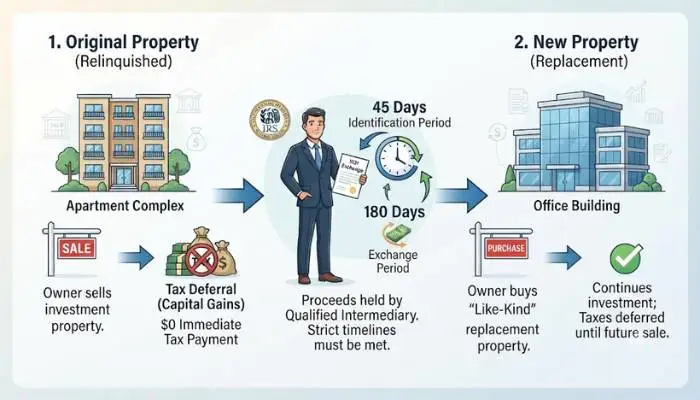
Section 1031 of the Internal Revenue Code allows real estate investors to defer capital gains taxes. You sell a property held for business or investment. You use the proceeds to buy another like-kind property. The tax is not eliminated. It is deferred .
This is not a simple sale. You cannot take the money yourself. A qualified intermediary must hold the funds. If you touch the money, the exchange fails .
Read More: Investment Strategies for Short Term Financial Goals: Smart Ways to Grow Your Money Fast
Basic 1031 Exchange Rules
What Properties Qualify?
The property you sell and the property you buy must both be held for business or investment purposes. Primary residences do not qualify. Fix-and-flip properties also do not qualify .
The like-kind rule is broad. You can exchange raw land for an apartment building. You can exchange a warehouse for office space. As long as both are investment real estate in the US, they qualify .
The Two Deadlines
These are the most important 1031 exchange rules. You have two strict deadlines :
-
45 days to identify replacement properties in writing
-
180 days to close on the replacement property
Both timelines start on the day your old property closes. Weekends and holidays count. If Day 45 falls on Christmas, that is your deadline .
The Identification Rules
You have three options to identify properties :
| Rule | Max Properties | Value Limit | Best For |
|---|---|---|---|
| Three-Property Rule | 3 | None | Most investors |
| 200% Rule | Unlimited | Total value ≤ 200% of sold property value | Diversifying into many properties |
| 95% Rule | Unlimited | Must acquire 95% of identified value | Rarely used |
Most investors use the three-property rule. It is simpler. You can identify three properties of any value .
The Qualified Intermediary
You must use a qualified intermediary. This is a neutral third party. They hold your sale proceeds between the sale and the purchase. If you take the money yourself, even briefly, the exchange fails .
Reinvest All Proceeds
To fully defer taxes, you must :
- Buy property of equal or greater value
- Reinvest all cash proceeds
- Replace all debt or add new debt
If you take cash or reduce debt, you pay tax on that amount. This is called "boot."
Advanced 1031 Exchange Strategies
Diversification Strategy
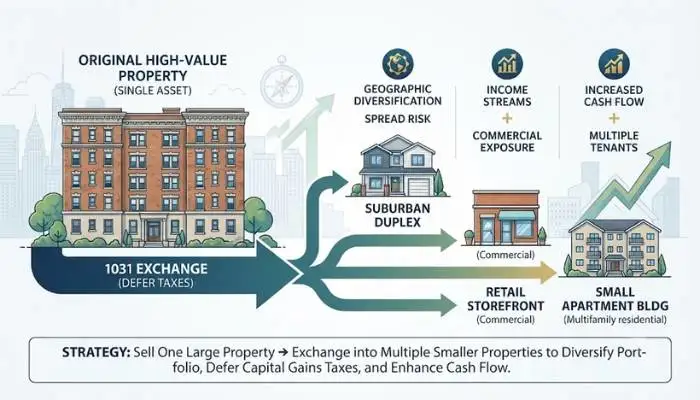
Many investors use a 1031 exchange to diversify. You sell one large property and buy several smaller ones in different markets. This reduces your risk .
The challenge is identification. If you want to buy five properties, you cannot use the three-property rule. You must use the 200% rule. You can identify any number of properties as long as the total value does not exceed 200% of the property you sold .
For example, you sell a property for $5 million. You can identify properties worth up to $10 million total. You can then pick the best ones to buy .
Related Party Sales
You can sell your property to a family member and still do a 1031 exchange. But there is a catch. The IRS puts a tracking device on both properties. The two-year rule requires that both you and the related party hold the properties for two years. If your relative sells within two years, your exchange fails .
If you sell to a related party, get a written agreement. The buyer should promise to pay your taxes if they sell early .
The 1031 Exchange 5-Year Rule Explained
- The 1031 exchange 5-year rule is about converting an investment property into your primary residence.
- You cannot use a 1031 exchange directly on a primary residence . But you can use a 1031 exchange to buy an investment property. Then, later, you can move into it .
- Here is the rule: If you acquire property through a 1031 exchange and later convert it to your primary residence, you must own it for at least five years before claiming the Section 121 capital gains exclusion .
- The Section 121 exclusion lets you exclude up to $250,000 ($500,000 for married couples) of capital gains when selling your primary residence. For 1031 exchange properties, you must own the property for five years. You must also live in it for at least two of those five years .
Remember: depreciation recapture from the rental period is always taxable .
You May Also Read: Real Estate Investment Strategies: A Simple and Clear Guide for Beginners
DST and 721 Exchange Strategy
For investors who want to exit active management, there is a three-step strategy :
- 1031 Exchange into a Delaware Statutory Trust (DST)
- The DST qualifies as replacement property
- Later, a 721 exchange converts the DST into REIT units
This lets you defer taxes and become a passive investor. You stop dealing with tenants and toilets. You get professional management and diversification .
But you give up control. You cannot do another 1031 exchange after this. It is a one-way ticket .

Best 1031 Exchange Companies
Choosing the right qualified intermediary is critical. Here are the top providers :
| Company | Best For | Insurance |
|---|---|---|
| IPX1031 | Overall expertise | $100M bond + $50M guaranty |
| Exeter 1031 Exchange | Complex exchanges | Varies |
| 1031 Services Inc. | Multiple exchange types | Varies |
| 1031X | Transparent pricing | Varies |
| First American Exchange | Online services | Varies |
| Computershare Corporate Trust | Simple exchanges | Varies |
IPX1031 is the largest provider. It is backed by Fidelity National Financial, a Fortune 500 company. It offers $100 million in fidelity bond coverage .
Common Mistakes to Avoid
1. Waiting Too Long to Start
The 45-day clock starts the day you close. If you start looking after closing, you may not find a good property in time. Start your search before you sell .
2. Missing the Deadline
Missing Day 45 or Day 180 kills the exchange. You will owe taxes, penalties, and interest .
3. Taking the Money
If you receive the sale proceeds directly, the exchange fails. Always use a qualified intermediary .
4. Not Having Backup Properties
Your first choice may fall through. Identify backup properties. If you cannot close on one, you have others .
5. Rushing Into a Bad Deal
The tax benefits are great, but do not buy a bad property just to save taxes. It is better to pay some tax than to own a money-losing asset .
FAQs
1. Can I use a 1031 exchange for a primary residence?
No. The property must be held for investment or business purposes. A primary residence does not qualify .
2. How long do I have to complete a 1031 exchange?
You have 45 days to identify replacement property and 180 days to close. Both start on the day your old property closes .
3. What happens if I miss the 45-day deadline?
The exchange fails. You will owe capital gains tax and depreciation recapture .
4. Can I buy a property from a family member?
Buying from a related party is risky and generally not allowed. Selling to a related party is allowed but comes with a two-year holding requirement .
5. What is the 1031 exchange 5-year rule?
If you convert a 1031 exchange property into your primary residence, you must own it for at least five years before claiming the Section 121 capital gains exclusion .
6. How many properties can I identify?
You can identify up to three properties of any value. Or you can identify more using the 200% rule, as long as total value stays under 200% of your sold property .
7. What are the best 1031 exchange companies?
IPX1031, Exeter 1031 Exchange, and First American Exchange are top-rated providers. IPX1031 is the largest and offers the most insurance coverage .
8. What is boot in a 1031 exchange?
Boot is any cash or non-like-kind property you receive. It triggers taxable gain. Common sources include cash leftover and debt reduction .