
Making money from property does not have to be risky. Many people think real estate is only for the rich or the lucky. But that is not true. There are smart ways to start with little money and low fear. This guide shares simple low risk real estate investment tips that anyone can follow. Whether you have savings or you are starting from zero, these ideas work. You do not need to guess the market or take huge loans. You just need to know the right steps.
We cover the best real estate investment strategy for beginners. We give real estate investing tips that are practical and safe. If you are learning how to make money in real estate for beginners, this is for you. Start your first real estate investment the right way.
What Makes a Real Estate Investment Low Risk?
Not all property investments are the same. Some are safer than others. A low risk investment focuses on steady income and long-term growth, not quick profits. It does not rely on guessing the market or taking huge loans.
According to UBS, residential real estate has defensive characteristics and can generate stable income even during uncertain times . It is more stable than stocks and provides regular cash flow through rent. This makes it a good "anchor" for your investment portfolio.
Core real estate is the most conservative strategy. It focuses on properties that are already occupied and generating rent. The return comes mostly from income, not from hoping the price goes up . This is the safest way to start.
Read More: How to Rent a House as a Landlord: Netherlands Guide
Real Estate Investment Strategies for Beginners
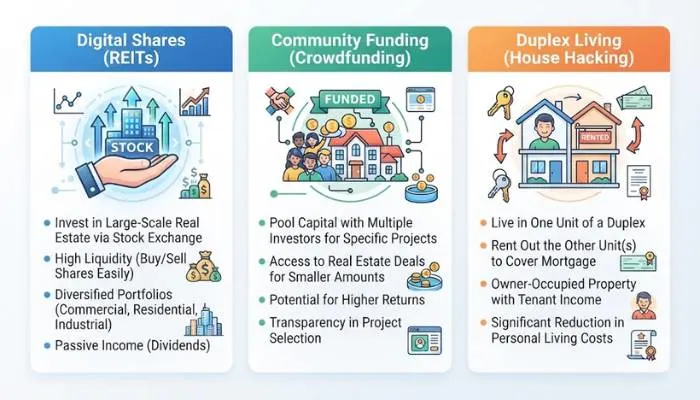
When you are starting out, you have several options. Some need very little money. Others need more but give you more control.
1. Real Estate Investment Trusts (REITs)
This is the easiest way to start. REITs are like mutual funds for property. You buy shares in a company that owns rental properties. The company pays you a share of the rental income as dividends.
- Why it is low risk: You do not need to buy a property yourself. You do not deal with tenants or repairs. You can buy and sell shares easily. You can start with as little as a few thousand rupees.
- What to watch: You do not control the properties. The returns depend on how well the company manages them.
2. Crowdfunding Platforms
Platforms like Fundrise and others pool money from many investors to buy properties. You can start with as little as $10 to $100 . You pick a project, and the platform handles the rest.
- Why it is low risk: You do not need to be a landlord. The platform does all the work. You get professionally managed deals without the traditional upfront costs.
- What to watch: Your money is locked in for a few years. Returns are not guaranteed.
3. House Hacking
This is the best way to start with little money. You buy a home, live in one part, and rent out the rest. This could be a basement apartment, an extra bedroom, or an entire unit in a duplex .
- Why it is low risk: The rental income helps cover your mortgage, insurance, and taxes. Your living costs drop significantly. You build equity while someone else pays part of your loan.
- What to watch: You have to live with tenants. You are responsible for maintenance.
4. Buy-and-Hold Rentals
This is the classic strategy. You buy a property and rent it out for the long term. The goal is steady cash flow and property appreciation over time.
- Why it is low risk: You get regular income. Property values tend to rise over the long term. You get tax benefits like deductions for mortgage interest and maintenance .
- What to watch: You need to manage tenants and repairs. You can hire a property manager, but that costs money.
Low Risk Investment Tips

Here are the most important rules to follow for a safe investment.
1. Do Not Rely Only on Price Appreciation
Many new investors focus only on how much the property value might go up. This is risky. Prices can fall. Instead, focus on the cash flow a property can produce. If the rent covers your costs and gives you some profit, you are safe even if prices do not rise .
2. Avoid Overleveraging
Do not take too much debt. If you borrow too much, even a small market downturn can break you. Keep a healthy debt-to-equity ratio. Keep cash reserves for unexpected expenses or vacancies . When rents drop or tenants leave, you still have to pay the loan.
3. Do Your Due Diligence
Never rush into a purchase. Conduct thorough market research. Get a detailed property inspection. Analyze potential cash flow, expenses, and return on investment . Check average rents, property taxes, and expected maintenance costs. If you skip this, you will regret it.
4. Do Not Underestimate Expenses
Many beginners forget the extra costs. Taxes, insurance, maintenance, property management fees, and capital expenditures like roof repairs add up quickly . Use conservative estimates in your financial projections. Always budget for the worst case.
5. Consider Professional Property Management
Do not try to manage everything yourself if you are new. It takes time and skill. If you self-manage, educate yourself on landlord-tenant laws. Set up systems for tenant screening, rent collection, and maintenance . Or hire a professional to handle it.
6. Diversify Across Different Triggers
Geography is not diversification. A flat in Whitefield and one in Gachibowli might seem different, but both depend on the same IT sector . Diversify across different demand drivers: employment anchors (IT hubs), infrastructure catalysts (metro corridors), urbanisation spillover, and yield plays (rental demand) . This protects you when one sector slows down.
Common Mistakes to Avoid
1. Chasing High Yields Without Checking Risk
High rental yield is attractive, but it often comes with higher vacancy risk, maintenance costs, or regulatory issues. Look at total return (yield + appreciation), not just rental income .
2. Flipping Without Experience
Fix-and-flip can give quick profit, but it is risky. Unexpected costs, contractor delays, and market changes can eat your profit. Profits from flipping are also taxed at a higher rate . This is not a beginner strategy.
3. Forgetting Tax Implications
Understand the tax consequences. Know about deductions, depreciation benefits, and strategies like 1031 exchanges for tax-deferred growth . Work with a tax professional familiar with real estate investments.
4. Underinsuring Your Property
Do not buy cheap insurance. Get comprehensive coverage. Consider additional coverage like flood or earthquake insurance if needed. Umbrella policies give added liability protection . One small accident can wipe out your investment.
You May Also Read: Tips to Grow Real Estate Business Fast | Easy Guide
Comparison of Low-Risk Strategies
| Strategy | Money Needed | Risk Level | Best For |
|---|---|---|---|
| REITs | Very low (5,000+) | Low | Passive investors who want liquidity |
| Crowdfunding | Low ($10-$100) | Low-Medium | Diversified passive exposure |
| House Hacking | Moderate (down payment) | Low | First-time buyers with a place to live |
| Buy-and-Hold (Single-family) | Moderate to High | Low-Medium | Long-term wealth builders |
| Buy-and-Hold (Multifamily) | High | Medium | Scaling cash flow |
Is Now a Good Time to Start?
The market has seen a period of repricing. Higher interest rates have slowed transaction activity, but this also creates more attractive entry points for long-term capital . Current pricing seems near the bottom of the cycle .
Income will be the key driver of returns going forward. This is a return to normal. Even the downside case shows positive income growth across nearly all property types . Residential and necessity-driven properties (grocery, medical office, senior housing) are likely to outperform more cyclical sectors .
FAQs
1. What is the best real estate investment strategy for beginners?
Buy-and-hold rentals and REITs are the safest for beginners. House hacking is also excellent because it reduces your own living costs.
2. How much money do I need for my first real estate investment?
You can start with very little through REITs or crowdfunding. For physical property, you need a down payment (usually 10-20%) plus closing costs.
3. How do I make money in real estate for beginners?
Through rental income (cash flow) and property appreciation over time. Focus on cash flow first, not just price growth .
4. What is the safest type of real estate investment?
Core real estate (stabilized, income-producing properties) and REITs are the safest. They focus on existing cash flow, not speculation .
5. What is house hacking?
Buying a home, living in part of it, and renting out the rest. The rental income helps cover your mortgage and other costs .
6. Should I manage my rental property myself?
If you are new, consider hiring a property manager. If you self-manage, learn landlord-tenant laws and set up proper systems .
7. What is overleveraging and why is it bad?
Taking on too much debt. It leaves you vulnerable to market downturns. If rents drop or vacancies rise, you cannot pay the loan .
8. Why is diversification important in real estate?
It protects you when one sector or market slows down. Diversify across different demand drivers (IT hubs, infrastructure, yield plays), not just different cities .