
You want to invest in real estate. But buying a flat needs lakhs of rupees. You do not have that kind of money. And you do not want the headache of tenants and repairs. There is another way. You can invest in REITs. They let you own a piece of big office parks and malls. You get rent as regular payouts and you can start with just a few thousand rupees.
This guide explains how to invest in REITs for beginners in simple words. It covers the best REIT investing for beginners with small amount options. It also lists the top 10 REITs and explains REIT investing for beginners with small amounts in India.
What is a REIT?
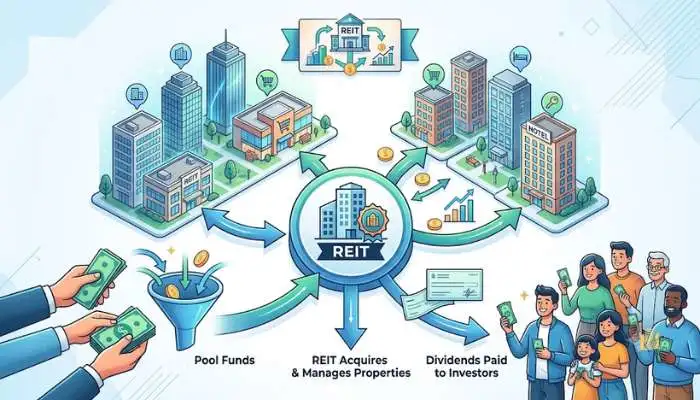
A REIT is a Real Estate Investment Trust. It is a company that owns income-generating property. Think of big office parks, shopping malls, or warehouses. The REIT rents these spaces to companies. It collects rent. Then it pays most of that rent to investors like you .
In India, SEBI rules say a REIT must pay at least 90% of its net cash flow to unit holders . So you get regular income. You do not have to find tenants or fix leaking taps. A professional team manages everything .
You buy REIT units on the stock exchange. They trade like shares. You can buy and sell them through your demat account .
Read More: Is Real Estate a Good Investment for Beginners?
Why REITs Are Good for Beginners
1. You can start small.
You do not need lakhs. One unit of an Indian REIT costs roughly 100 to 400. You can start with a few thousand rupees .
2. You get regular income.
REITs pay out cash every quarter or half-year. The yield is usually 6% to 7% . This is better than many fixed deposits.
3. You do not manage anything.
No tenants. No repairs. No legal paperwork. The REIT manager handles it all .
4. You can sell easily.
REIT units trade on NSE and BSE. You can sell them on any trading day. Selling a flat takes months. Selling a REIT takes seconds .
5. You own a piece of prime property.
One REIT unit gives you a share in multiple Grade-A office buildings. This spreads your risk across many tenants and cities .
How to Invest in REITs for Beginners?
The process is simple. Here are the steps.
Step 1: Open a Demat and Trading Account
You need a demat account to hold REIT units. You also need a trading account to buy and sell. Most brokers offer both. If you already invest in shares or mutual funds, you have this ready .
Step 2: Find the Listed REITs
Search for REIT names on your broker's app. In India, you will find a few main ones. We list them below.

Step 3: Check the Key Numbers
Do not buy blindly. Look at these numbers:
- Distribution Yield: The annual payout as a percentage of the unit price. A 6% to 7% yield is normal for Indian REITs .
- Occupancy Rate: How much of the property is rented. Higher is better. Look for 90% or more .
- WALE (Weighted Average Lease Expiry): How long until leases expire. Longer is safer. It means steady income for more years .
- NAV (Net Asset Value): The estimated value of the properties minus debts. If the unit price is below NAV, it may be a good deal .
Step 4: Place a Buy Order
It works like buying a share. Enter the REIT name, the number of units, and the price. Your units will appear in your demat account in a couple of days .
Step 5: Decide on Reinvestment
You will get payouts. You can take the cash. Or you can reinvest it to buy more units. Reinvesting helps your money grow faster.
Top 10 REITs to Know
India has only a handful of listed REITs. Here are the main ones, plus some global names you may hear about. This is not a recommendation. Always do your own research.
Indian REITs
1. Embassy Office Parks REIT
India's first REIT. It owns big office parks in Bengaluru and other cities. Tenants include global companies. Yield is around 7% to 8% .
2. Mindspace Business Parks REIT
Owns office parks in Hyderabad, Mumbai, Pune, and Chennai. It has high occupancy (around 94%) and strong rental growth potential .
3. Brookfield India Real Estate Trust
Backed by Brookfield, a global asset manager. Owns offices in Mumbai, Noida, Gurugram, and Kolkata. It is actively buying more assets .
4. Nexus Select Trust
India's first retail mall REIT. It owns malls like Select CITYWALK in Delhi. Retail REITs work differently from office REITs. They depend on shopper footfall .
5. Knowledge Realty Trust
A newer REIT. It entered the market in 2025. It is smaller but growing .
Global REITs (for awareness)
If you invest internationally, you may come across these names. They are among the largest globally.
6. Prologis – Warehouses and logistics.
7. American Tower – Cell towers and data infrastructure.
8. Equinix – Data centers.
9. Simon Property Group – Shopping malls.
10. Realty Income – Freestanding retail properties.
For an Indian beginner, the four main Indian REITs are the easiest place to start. You can buy them on NSE or BSE.

REIT Investing for Beginners with Small Amounts
You do not need a big lump sum. Here are ways to start small.
Start with One Unit
One unit costs 300 to 500. Buy one. See how it feels. Watch the price move. Collect your first payout. Learn the rhythm before putting in more money .
Use a SIP-Like Approach
Do not invest all at once. Buy a few units every month. This averages out your cost. If prices fall, you buy more units for the same money. If prices rise, you still own what you bought earlier .
Reinvest Your Payouts
When you get a payout, use it to buy more units. Over time, this compounds. Your units grow. Your payouts grow. This is a slow but steady way to build a position .
Keep It Simple
You do not need to buy every REIT. Pick one or two with good occupancy and a track record. Learn how they behave. Add more later if you feel comfortable.
You May Read Also: How to Make Money in Real Estate for Beginners
What Are the Risks?
REITs are not fixed deposits. They have risks.
1. Price can fall.
REIT unit prices move with the stock market. If the market falls, your units may be worth less than what you paid. You can lose money if you ell at the wrong time .
2. Interest rates matter.
When interest rates rise, REIT prices often fall. When rates fall, REIT prices usually rise. This is because investors compare the REIT yield to other options .
3. Tenant risk.
If a big tenant leaves, the REIT loses rent. Vacancy goes up. Payouts may drop. Always check the occupancy rate and tenant mix .
4. Tax on payouts.
REIT payouts are not fully tax-free. The interest portion is taxed at your income slab. Capital gains are taxed when you sell units. Understand the tax before you invest .
FAQs
1. How much money do I need to start investing in REITs?
You can start with the price of one unit. In India, that is roughly 300 to 500. A few thousand rupees is enough to begin .
2. Can I buy REITs with a regular demat account?
Yes. You do not need a special account. REITs trade on NSE and BSE like shares. Any demat and trading account works .
3. What is the best REIT for beginners in India?
There is no single "best." Look for REITs with high occupancy (90%+), a long WALE, and a stable track record. Embassy, Mindspace, and Nexus are the main options to study .
4. How often do REITs pay?
Indian REITs pay at least twice a year. Some pay quarterly. The payout is called a distribution .
5. Are REITs safe?
They are safer than buying a single property because they are diversified and regulated. But they are not risk-free. Prices can fall. Payouts can change. Do not put all your money in one REIT .
6. What is a good yield for a REIT?
Indian REITs typically yield 6% to 7%. Some retail REITs may yield slightly more. Compare the yield to fixed deposits and other income options .
7. Can I sell my REIT units anytime?
Yes. They are listed on the stock exchange. You can sell them on any trading day. This is a big advantage over physical property.
8. Do I need to pay tax on REIT payouts?
Yes. The interest portion of the payout is taxed at your income slab. Dividends may be exempt. Capital gains are taxed when you sell. Check the latest tax rules before investing .