Selling an inherited property in India is not the same as selling a house you bought yourself. The law sees you as a caretaker of someone else's asset, not the original owner. That changes everything — the paperwork, the tax math, and who has the right to sign the sale deed. Most families get stuck here because they assume blood relation is enough proof of ownership. It is not.
If you want to know how to sell an inherited property without legal disputes or a heavy tax bill, you must first fix the title, understand the cost rule, and get every legal heir on the same page. This guide shows you exactly how to do that, step by step.
What Is Inherited Property?
Inherited property is what you receive after a person passes away. It comes to you either through a registered Will (the person wrote it down) or through the law of succession (no Will exists, so the law decides who gets what).
This is different from "ancestral property." Ancestral property usually means a property that has passed down four generations in a Hindu Undivided Family without being divided. The rules for ancestral property are stricter. For example, a son may have a birthright in ancestral property, but he does not have an automatic birthright in a property his father inherited from his own father under the Hindu Succession Act . For selling purposes, the tax treatment is similar, but the ownership rights can be messier.
Read More: Home Selling Price Calculator: Estimate HDB Sale Proceeds

The important point: The moment you inherit, you become a joint owner with other legal heirs. If your father passed away and left no Will, you, your mother, and your siblings all own a piece of that flat. You cannot sell the whole flat alone. You need everyone on the same page.
Step 1: Get the Paperwork Right (Before You List)
Do not call a broker yet. Do not put a "For Sale" board. First, fix the title.
Get the Death Certificate. You need multiple copies. The municipality or panchayat issues this. Every bank, society, and registrar will ask for it .
Get the Legal Heir Certificate or Probate. If there was no Will, apply for a Legal Heir Certificate from the Tehsildar or revenue office. This document names who the legal heirs are. If there was a Will, you may need Probate (a court stamp that proves the Will is valid). Probate is not always compulsory, but most buyers and banks will insist on it before giving you money .
Update the Records. The property tax receipt, the mutation entry (khata or patta), and the society records must show the heirs' names. If the society register still shows the dead person's name, the sale will stall. Apply for mutation at the local revenue office.
Handle the "NRI Sister" Problem. If one heir lives abroad or does not want to sell, they must sign a Relinquishment Deed. This is a registered document where they give up their share in favor of the selling heir. A notarized paper is not enough. It must be registered at the Sub-Registrar's office. If the heir is abroad, they can sign a Power of Attorney, but it must be notarized and apostilled in that country .
Step 2: How to Calculate Tax on Sale of Ancestral Property?
This is where most people lose money because they do not understand the "cost" rule.
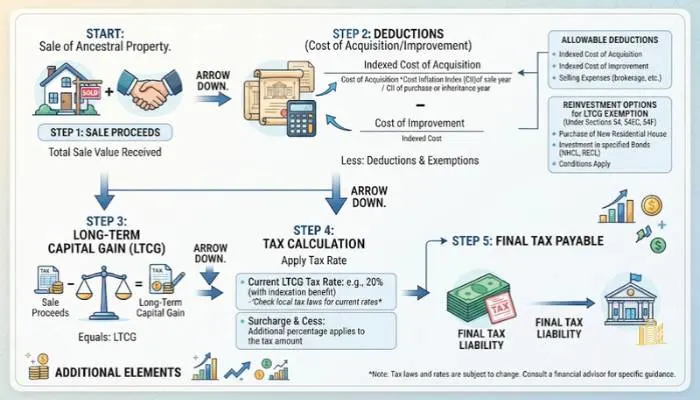
The Golden Rule: Your cost of acquisition is the cost the previous owner paid. Not zero. Not the current market value. If your grandfather bought the land in 1980 for 50,000, your cost is 50,000 .
The Holding Period: The clock does not start when you inherited it. It starts when the original owner bought it. If your father held the flat for 15 years before passing it to you, and you sell it after 2 years, the total holding period is 17 years. It is treated as a Long Term Capital Asset .
The Indexation Trick (For Old Properties): If the property was bought before 1st April 2001, you have a choice. You can use the actual cost paid by the previous owner, or you can use the Fair Market Value (FMV) of the property as on 1st April 2001. The FMV cannot be higher than the stamp duty value on that date. This usually pushes the cost up significantly, reducing your taxable profit .
The Tax Rate: For sales after 23rd July 2024, the tax is generally 12.5% without indexation. However, if you are a resident individual selling a property acquired before that date, you can choose the lower of: 12.5% without indexation, or 20% with indexation. You need to run both calculations and pick the one that saves you money.
Step 3: How to Avoid Capital Gains Tax on Inherited Property?
You can legally pay zero tax. The law gives you two main doors.
Door 1: Section 54 (Buy Another House). If you sell a residential house and use the profit to buy another residential house in India, the tax is waived. The timeline: Buy the new house within 2 years of selling, or construct it within 3 years. You must not sell this new house for at least 3 years. If you cannot buy immediately, deposit the money in a Capital Gains Account Scheme (CGAS) before your ITR filing deadline .
Door 2: Section 54EC (Bonds). If you do not want to buy another house, invest the profit in specified infrastructure bonds. The limit is 50 lakh. You must invest within 6 months of the sale. The lock-in is 5 years. The interest you earn is taxable, but the capital gain itself is exempt .
One Warning: You cannot use Section 54 if you sell agricultural land. Rural agricultural land is not considered a capital asset at all, so its sale is not taxed in the first place. But if the land is in a municipal area, it is a capital asset and the rules apply .
Step 4: How to Sell an Inherited Property Online?
You can list the property on platforms like NoBroker, MagicBricks, or 99acres. But for inherited property, the online process is only for finding a buyer. The legal transfer still happens offline.
The Process:
-
List with Clear Photos. Take photos of the flat, not the old family photos on the wall. Buyers want to see the space, not your memories.
-
Be Ready for Questions. The moment a serious buyer asks, they will ask for the "Chain of Documents." Have the Death Certificate, Legal Heir Certificate, and the original Sale Deed of your father ready. If you fumble here, the buyer will assume you are hiding something .
-
The Sale Deed. The final document is the Sale Deed. Every heir whose name is on the inheritance must sign this deed at the Sub-Registrar's office. If an heir is dead, their share goes to their heirs, and you may need their documents too.
-
TDS. If the sale price is above 50 lakh, the buyer will deduct 1% TDS. This is normal. It goes to the government against your PAN .
You May Also Read: How to Inrease Property Value Fast Before Selling a Home
Common Mistakes to Avoid
Mistake 1: "I am the only son, so I own it." No. If your mother is alive, she has an equal share under the Hindu Succession Act. If your father died without a Will, you cannot sell the house without her signature. If she is not willing, you need a partition deed or a court order .
Mistake 2: "We will split the money later." Get the split in writing. The Sub-Registrar will ask how the sale consideration is distributed. If there is a dispute, the registrar can stall the registration. Have a family settlement or release deed ready before you find a buyer.
Mistake 3: Forgetting the CGAS. If you sell in March and plan to buy a house in October, the money sitting in your savings account will be taxed. You must open a Capital Gains Account Scheme with a bank before the ITR due date to protect the exemption .
FAQs
1. Is inherited property taxable when I receive it?
No. There is no tax when you inherit. The tax comes only when you sell .
2. Can I use my grandfather's purchase price if my father inherited it and then died?
Yes. The cost goes back to the last person who bought it. If your grandfather bought it, his cost is your cost. If your father bought it, his cost is your cost .
3. Do I need Probate to sell?
Technically, not always. Practically, yes. Most banks and buyers will not risk buying a property without Probate if there is a Will, because a hidden heir can challenge the sale later .
4. What if the property is in a village (agricultural land)?
Rural agricultural land is not a capital asset. You do not pay capital gains tax on selling it. But if it is near a city and falls under municipal limits, it may be treated as a capital asset .
5. Can I sell to an NRI buyer?
Yes, but the rules are different. The NRI buyer must pay TDS, and you may need specific bank approvals. Speak to a CA before signing anything.